Variations on a Sickness: a novella

Prelude

“I am a god. I’m not the God, I don’t think.”

–Phil Connors, Groundhog Day

Sickness is descending on the world…

…as crazy as that sounds, we should make one thing clear: I am not a liar. Quite the opposite, in fact. And I’m funny as hell.

You will notice—as I chew the fat, compose, consider, or whatever you want to call this—that two intense and mundane mini-epics are materializing simultaneously. It is not an uncommon duality, especially in a time such as these. It is what so many call “madness.” At first, the stories may seem distinct, that there are two…well, you can’t call them protagonists. Two antagonists?  two anti-heroes?  two tragic heroes? two tragic-antiheroes? Whatever it is you want to call the main character, the fact is—and it is the most important fact for you to know—what is happening to him is not the time-travel to parallel universes that it appears to be; it never is. Whether you call it “madness” is up to you.

At the risk of seeming too dictatorial about your experience in this space, don’t get caught up with inexactitudes, inconsistencies, non-binaries, or unlikelihoods: in a time of widespread sickness, impossibilities happen all the time. While we’re at it, don’t get too bent out of shape about the obliviousness, contradictions, and willful ignorances of our person: Julius. And if you’re looking for symbols or metaphors or parallels or motifs, you may find them. But don’t hold out hope that Julius will also observe these devices. You see, the fellow I am going to tell you about is not too observant, which means he’s not even close to being the absurd humorist. Not for lack of trying, though.

It’s not that he’s stupid; it’s just that Julius is not attuned to such things and will therefore never see symbols or metaphors or parallels or motifs. To be more accurate, he does see them, but he will either move quickly past their significance altogether, or he will misinterpret them. Put another way, Julius rarely sees the things that have flashing neon arrows pointing at them; even more rarely does he see things that have peacock feathers coming out of their ass.

But, dear audience, critic, witness, or whatever it is you might call yourself: you yourself will see things you wish Julius would see. This is all we can hope for. But even in this most extraordinary time of imminent global sickness, there is little hope for Julius.

As to what or who or where or why I am, well, suffice it to say that I am the only way a story like this can—or should—happen.

Now that we have those things cleared up, a sickness is descending upon the world.

bleach

photo credit: OnTimeSupplies.com

syringe

photo credit: Valley Vet Supply


writing ritual – music

Writing routine. Writing ritual. I like the term writing ritual. Then the term is spiritual. Religious, even.

Over the course of writing The Emergent, I listened to certain albums for their familiar sounds and their contribution to my writing ritual. I wrote about it in this post.

On that note, I wanted to share the only playlist I listened to in the final six months of work on the book. Never listened out of order. The list is publicly available or you can recreate it on a different platform.

I wish I had 3 hours+ to write every session.

against performative allyship

I posted back in September that “I wrote The Emergent in order to subvert my very own American heterosexual white middle-class male point of view.”

In the spirit of that September post, the dedication in the front of the novel, and the Author’s Note in the back of the novel, I want to support voices that need to be heard more loudly and widely in the state of Iowa. Therefore, 60% of any royalties I receive from the book will be contributed to the local BIPOC Professionals Fund.


a tribute to my readers

Kat is ready to tell her story: coming of age at the dawn of the internet era.

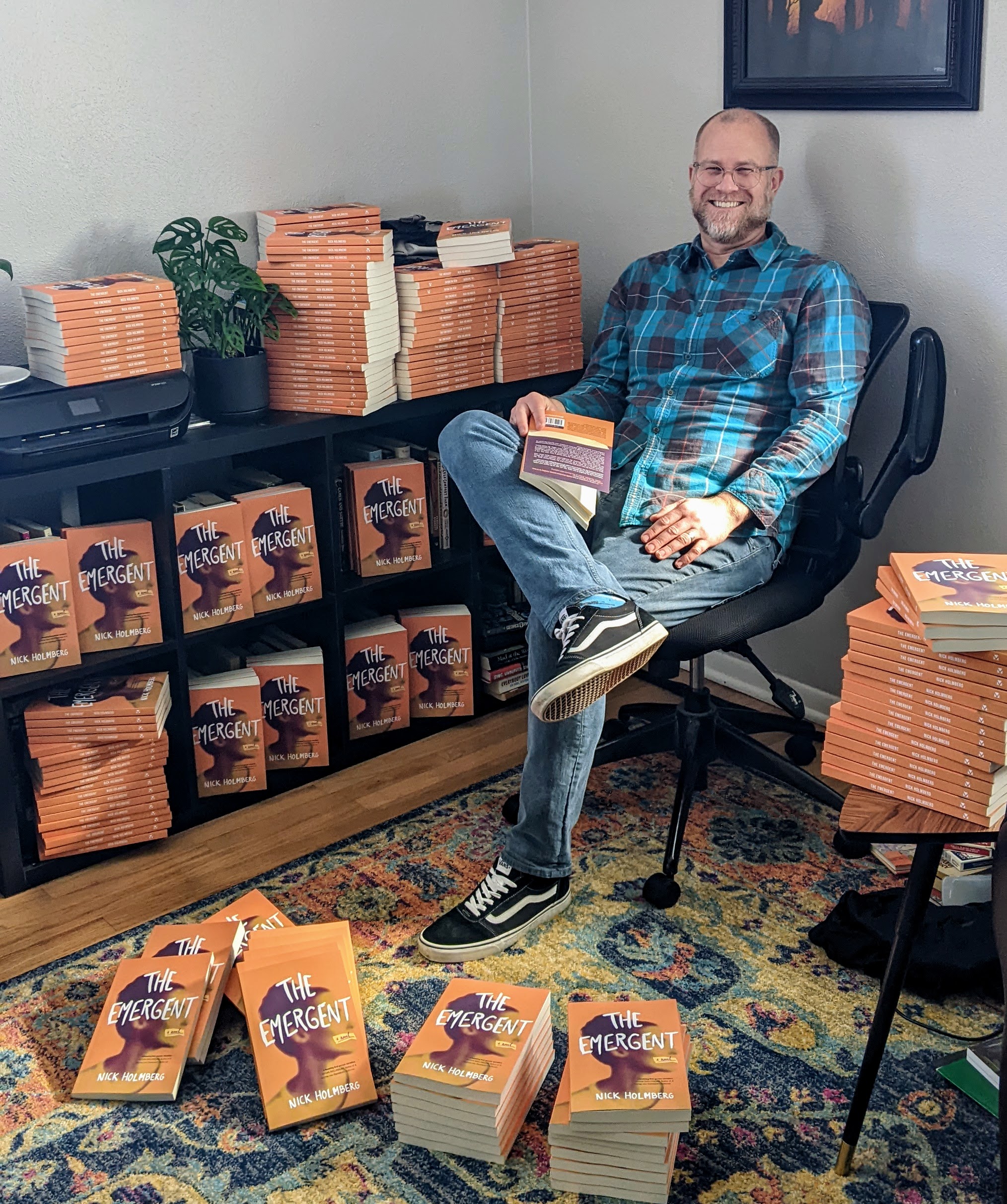
Lots of envelopes to stuff. Good thing it’s spring break next week.

 You did this.

Autumn 2002. You were with me in Mountain View, CA when I wrote the inciting incident of what would become my novel.

You were there.

Autumn 2004. You sat with me in the Harlem/Morningside Heights’ Café Amrita on 110th St & Frederick Douglass Circle as I finished the first 100-page draft of the manuscript.

You were there.

Winter 2005 thru summer 2006. You were a distant dream, dear reader. I stopped writing as my life crashed down around me in Sunnyvale, Willow Glen, & Campbell, CA. But you were there.

You were there.

Autumn 2006 thru summer 2010. You travelled with me throughout South Korea, where I completed the first full draft of the manuscript.

You were there.

Winter 2011 thru spring 2017. I almost lost you again, reader. Settling in northern Illinois, working several jobs, cooking for Nic through grad school, my own (money) career pursuits left no time for writing.

But you were still there.

Summer 2017 thru summer 2019. You kept me company as I carved out time to start writing again during marathon weekend sessions in Houston, TX.

You were there.

Autumn 2019 thru winter 2021. You were waiting for me in this Des Moines home office every morning as I drafted, tinkered with, and tweaked the manuscript (one hour a day before work, four to eight hours on the weekends).

You were there.

Because you were there all along, Kat is now here. Ready to tell her story.


dreams, coffee, and the invasion of smart phones

When I was in my early to mid-20s, I would do things in dreams unimaginable to me in waking life: inject heroin, die by gun suicide, die by gun murder, crash-land small jet planes in the San Francisco Bay.

Dreaming sounds dangerous. Yes, but not always. In one dream when I was 24—a couple year after a particularly bad heartbreak—I forgave the young woman who had crushed my soul.

Other than of the occasional dog attack, I don’t dream much anymore. After all the addiction, the dying, the near-death, the confrontation with deep emotional pain, you might say that’s a good thing.

I don’t.

The current dog-attack dreams are stark because they are the only ones that I remember. Since they are connected to real altercations with neighborhood dogs over the past two years, the dreams help make meaning.

The dog attacks of my dreams can represent any and all multitudes of secular fear: pandemic, politics, and their implications on the next generation.

The dog attacks of my dreams can represent a particularly unruly part of my inner Self (an interpretation less potent in my very domesticated mid-40s).

cover art for Tool’s Lateralus: Alex Grey

The dog attacks of my dreams can represent whatever I want them to, follies of possible self-delusion and misinterpretation notwithstanding.

The real trick, at least in the dream, is to vanquish the dog. Or befriend it.

Those dreams from my 20s still carry meaning, are part of my narrative, are the basis for a personal mythology, a personal religion. Those dreams are subconscious artifacts that mark a time of developing self-awareness, a time of great personal growth.

But have I lost my religion? Visions that could inform my life (i.e. sleep cycles that lead to remembered dreams) are interrupted by the biology of the old-ish (i.e. I gotta pee at 2 AM), as well as the physical aches and anxiety pains.

And there’s so much more that occupies waking life than there was in my 20s. Two more decades of personal and world history to process; responsibilities, regret, my relationship with friends and family to concern me. Personal growth continues; I interact with the joys and hardships of life and change. But that’s fairly artificial: the books, articles, television, and cinema that I consume will never fully reflect my own experience.

In a recent episode of Throughline, Abdelfatah points out that “in today’s world, where sleep is being cut short, caffeinated drinks are keeping us awake and screens vie for our attention, it’s become harder and harder to dream.” True. Can I quit coffee in the interest of better sleep? Can I refrain from my anxiety-inducing media addiction to foster more dreaming?

In my 20s—in the early days of my relationship with coffee and before the invasion of smart phones—I was able to take the experience of a dream and consider the metaphors, sometimes for several days. Sure, maybe I was a little interested in the escapism of taking heroin, but perhaps the dream was instructing me: temporarily extract yourself from your worries about school and love and change.

I could lament how much richer my inner life would be now if I were to remember more of my dreams. Or I could develop a practice of taking an extra five minutes before getting out of bed, letting the visions of sleep set in my waking mind so they could walk with me throughout the day.


It takes a village to raise a book

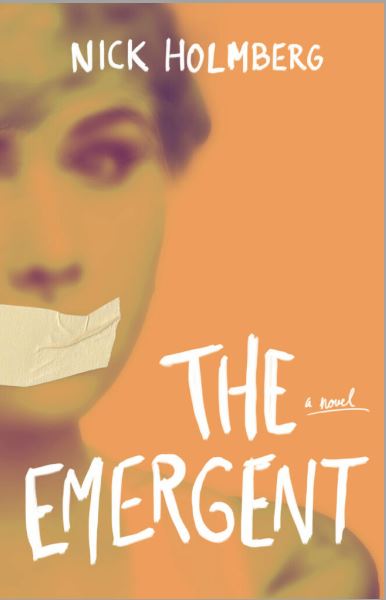
The cover for The Emergent has been selected. But think about this:

If you participated in phase two of this part of the project (the cover poll for The Emergent), you have judged book covers so that others may judge a book by its cover. Up to the point when the cover poll was released, only a handful of people were involved in the design and content of the book. Now, thanks to you and your sharing the poll around, almost 200 individuals (a small village) have contributed to the book becoming what it will be. I think that’s pretty dope (to use a phrase from the 90s).

UPDATE: publication date is now 3/30/2022. At a later date, I will share info on pre-orders and an e-book flash sale so you and all your all your friends can get copies.

Okay. Here’s what you really came for:

At the beginning of the process, I pulled a number of books off my shelves and shared their badass covers with the designer (see below). Other than an extended synopsis (with spoilers) of The Emergent, these book covers were the only thing influencing the designer in the first round.

The one below missed the mark completely; felt a bit like they did it quickly to fill a quota.

The second one (below) is supposed to evoke the Santa Clara Valley (the setting for much of the story). It’s a decent job of replicating the feel of another example I shared with the designer – a simple yet intriguing cover for an excellent book by an old acquaintance of mine.

Below are the two favorites. I asked for and got one “major” change. Can you see the difference?

While none of the endorsements appear in the images below and at least one minor correction needs to be made in the text, here’s what the ARC (advance reading/review copy) cover wrap looks like.


Lessons from a Tick

I would rather have lyme disease than admit this, but here goes: I have a tick.

After nearly two decades of working on The Emergent, you would think I had cured all the sentence-level “ticks.” Well, I have…now. A real buzzer-beater. Some serious Steph Curry magic. As I made my last pass of the manuscript last week, I discovered the tick. From now until publication, anything other than typo corrections is frowned upon.

What the heck is a “tick” for a writer? Generally, it’s a bad/clumsy habit in a person’s prose. For me, it was starting a sentence or a phrase with “there was” or “there were.” I discovered nearly 40 instances, made improvements to nearly all of them, and straight up deleted others. Here are some examples vs their re-writes:

There were reassuring whispers. When they stopped, I went searching for them.

vs.

The reassuring whispers stopped. And I went searching for them.

————

There was a question in her voice as she trailed off.

vs.

A question tinged her voice as she trailed off.

————

There were other stories that were just downright weird for Oso to be telling me.

vs.

Other stories were just downright weird for Oso to tell.

————

There was something changing in her that was somehow connected to the obligations she assumed.

vs.

Something was changing in her that was somehow connected to the obligations she assumed.

————

But there were two times that she changed the tradition.

vs.

She changed the tradition only two times.

————

When we arrived, the sun was out and there was no wind.

vs.

When we arrived, the sun was out and the air was still.

vs.

When we arrived, the sun was out and the air was still.

————

But there is rage and dissatisfaction in their music; it helps give me some idea of where the discontent of men comes from.

vs.

But their rage and dissatisfaction helps give me some idea of where the discontent of men comes from.


The Big Holiday Read

I’ve experienced 25 books this year. Granted, one of them was a children’s book. And much of my consumption consisted of audiobooks (can’t let my commute to work get in the way of a good story!).

But with a couple weeks off and my manuscript with the designer, I thought I’d try to reach 30 books by the end of the year by reading the hardcopies of the following books:

Mad at the World: A Life of John Steinbeck by William Souder (120 pages in as of now; if you know me at all, you know JS is my jam)

The Last One by Fatima Daas (debut novel from a French queer Muslim woman)

The Samurai’s Garden by Gail Tsukiyama (recommended by Aunt Dayle)

One Man’s Initiation: 1917 by John Dos Pasos (how is it I’ve never read any Dos Pasos? This is his debut; I’ve asked Santa to bring me the USA Trilogy)

This Side of Paradise by F. Scott Fitzgerald (rounding out the debut novel semi-theme, not quite sure how I missed reading this one over the years)

What would you recommend for my 2022 booklist?


Queen Lizzy is Unimpressed

Nic and I linger over breakfast during the autumn, entertained by the squirrels playing, forgetting where their food is, getting fat. We root for them to make it across the street, cheer when they’ve lived to cross another street. It’s the same every year here in the Midwest. This year, however, those little rascals seem to be particularly abundant. And this means that squirrel demise is on the rise: hawks, cars, falls from trees, loose power lines dangling from our utility pole listed as the cause of death in the coroner’s report. More than usual, the dead rodent this year dots my consciousness like spilled ink. Or a spreading pool of blood, as it were.

I once knew someone who, for religious reasons, travelled with a shovel in the trunk of their car, giving roadkill dignified ceremonies for undignified deaths. I was never sure how this person got their PhD—or ever made it to work on time: stopping for every dead animal they drove past. I am fairly certain this person did not grow up in the Midwest, where the accidental slaughter of wild animals is part of the landscape.

I do understand the sentiment, though. So on the several occasions in the past year when a fallen (but completely intact) squirrel lay lifeless in the street in front of my house (victim of a slippery utility pole or its stray electrical current), I have scooped up the rust-and-beige body with my yellow snow shovel and transported it to the wooded areas behind the property. I don’t go so far as to bury the poor bastards; but in my mind, it is more dignified to return the little guys to nature; at least then all the fat that they worked so hard to pack on in the closing days of autumn will not have been for nothing. I mean, isn’t there more dignity in being a snack for a turkey vulture than to be a pavement Jackson Pollock, innards forced out of either end?

The latter seems like a waste (unless you’re a diehard art fan), while the former seems to serve a purpose.

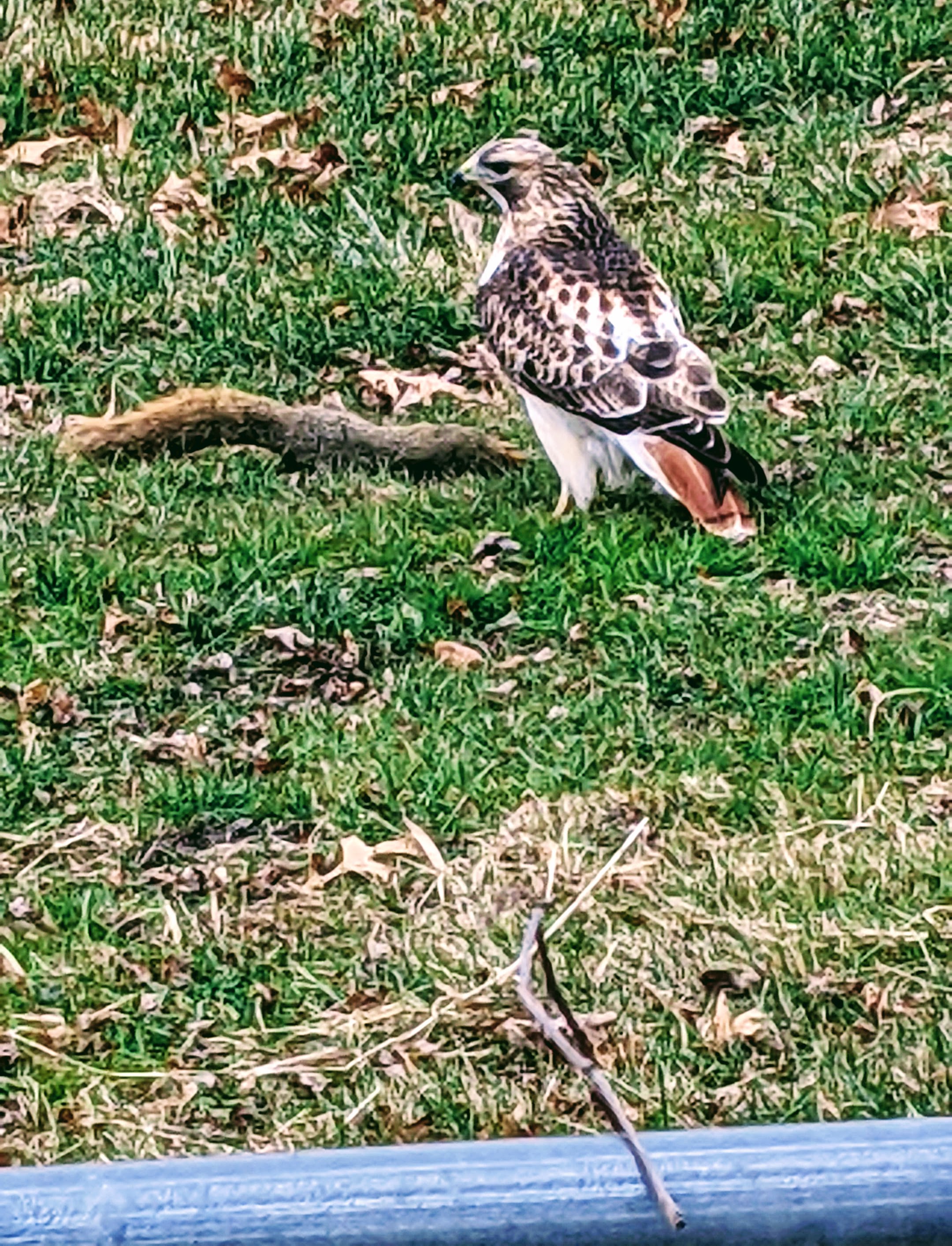
Just the other day, I transported the second little body of the week to the long grasses just beyond the 3-foot fence at the back of the yard, an offering to scavengers or worms. And today I worked from home. My office commands a fantastic view of the park, the capitol building seeming to sit atop the tree line. Backyard tree now with bare limbs, I had a clear view of a well-fed red tail hawk. We’ll call her Queen Lizzy.

In the past couple years of mostly working from home, I have never seen Queen Lizzy in our tree; she lives in the park trees a good 100 yards distant from my office window. She is graceful, soaring high on warm drafts in summer and darting at lower altitudes in winter. So to see Queen Lizzy not 20 yards from me—her white breast contrasted with her brown feathers and the gray day—brought my work to a grinding halt.  

Perched 15 feet up in the tree, she rotated her head 180 degrees each way. Then she spread her wings, quickly alighting on the 3-foot fence below. For several minutes, her head was on a swivel. She could not believe her good fortune, or she didn’t want anyone to see what she was about to do, or was looking at me incredulous at the stupidity of whatever animal she was hunting.

In a flash of brown-red-white, she hopped into the grass below, flew a few more feet and landed. It didn’t seem likely that the squirrel corpse I had laid there the day before would still be around: fox and coyote sometimes saunter through the park and they surely would have caught the scent of an easy meal. So I assumed Queen Lizzy had made a fresh catch of some living thing and was waiting for it to gasp its last under her death talons.

My curiosity got the best of me, as all I could determine from my vantage was that she was just standing over the body of her kill. I figured if she was startled by me, she could take her meal elsewhere in those death talons. I was a mere 15 yards from her when I stopped at the back fence line. She did not fly off immediately. Her dignity had suffered a blow: she was embarrassed for having thought the squirrel was alive, mortified to have been seen with a squirrel she herself had not caught. More than anything, though, she was unimpressed with my offering.

Queen Lizzy flew off, mumbling something about how dining al fresco didn’t mean the meal had to be cold, too.