Maybe you’ll think I’m in need of medication when I profess my love for the writing process. If I talk about the creative process too much, I will quickly veer off topic. Besides, it might get a little woo-woo metaphysical, a little florid, a little poetical. Hell, even a little mystical.
You see, I don’t want to write about the writer’s hustle. I don’t want to admit the sheer volume of time I spend in endless social media algorithmic guessing games (AKA shamelessly self-promoting into the void). I don’t want to admit how jaded I can become at the bowing and scraping I have to do, much of which is for naught. Every time I send out a query or a short story, my dignity—indeed, my spirit—is implicitly threatened. The incessant trickle-trickle drip-drip of rejections that I have gotten over the years is enough to drive me to quit writing altogether. Why would I want to relive all those little traumas? I would much rather write about the recursive nature of writing and editing, the very cycle of creation and destruction in the process of creating worthwhile art.
See? Told you. Borderline woo-woo.
You might say I have a problem. When I hear “No” from a publisher, I reply, “Thank you! May I have another?” There’s plenty of evidence that I’m masochistic in this regard, as I have been trying to get short stories published for over twenty years (order my first published story today). And before my debut novel, The Emergent, was hybrid-published, it took nearly two decades of crafting it with elements of psychological mystery, coming-of-age, family saga, and magical realism. I must be glutton for punishment, thinking for a long while that a modern traditional publisher or agent would have accepted an unknown white hetero dude writing from at least two appropriated perspectives.
I won’t write here about all the hustle and general insanity it takes to get others to publish your work. Contact me to set up a consultation. Suffice it to say that, as an independent writer, getting my writing to market took hustle. Or delusion. Take your pick. But, being an un-agented genre-defying writer makes the hustle-delusion that much more acute.
Instead of focusing on my long line of failures in winning the approval of publishers and lit magazine editorial boards, I’d rather write about the more interesting side of the hustle: talking to folks about the woo-woo side of my writing process. You don’t need the gory details here about endless submissions. What should come across in this post is my love of writing. And trying to prove to publishers what I already know—that my writing is good or that water is wet—is a necessary evil. Once I accepted that the popularity and profit are inaccurate gauges for quality, my job as a writer became easier.
And in an ideal world, popularity and profit would not drive your artistic endeavors.
I’m not saying any of this to portray myself as something I’m not. I ain’t a bloviating egotistical writer-type, despite what my rant here may tell you. I’m simply a writer-type. No stereotypical egotism. Just a writer-type.
Better that than a typewriter. What a life. Born to get punched.
To flog a pun into a bad metaphor, being a writer-type really does mean rolling with the punches, all the small jabs along the way can slowly wear you down over years or, in my case, decades. Fortunately for me (and the folks who have heard me speak at public libraries, on podcasts, or on WHO-TV’s “Hello, Iowa”), the act of writing has never felt like a chore—even when I’m trying to repair the gaping plot holes and stumbles in poetic narratives caused by me killing my darlings. Creative writing has never been work (if it were, I should have demanded a higher wage and maybe some health bennies!). And writing has been only moderately about my quest for Steinbeck-like fame (that dude had ideas that resonated, he had ideas that he researched, wrote about, published to a wide audience, hated to discuss and defended. All this, he did for a living).
Even if you’re not like me—masochistic, self-proclaimed spiritual being intent on being moderately all Steinbeckian and shit—, a published independent writer cannot just sit back and watch their baby go out in the world. This is to say, if you watch and hope for the best, your book will easily get lost in the sea of 4 million books that are published each year. No matter how you publish—self, hybrid, or traditional—hustle after publication is the name of the game.
The decades I have been tapping away on my laptop writing my great American novel have been instructional to my inner life. It has been a spiritual practice to wake and write every morning at 5 AM to create and coax my darlings to do my bidding—or a reasonable facsimile thereof. But over the last year and a half since the release of my novel, the hustle—booking, preparing for, and travelling to attend events—has taken energy. And it takes energy to poorly conjure super-keyworded and algorithmically steroidal social media content. All this promotional energy often has usurped time for my cherished, protected one-hour process practice: my daily 5 AM communion with syntax, vocabulary, and structure.
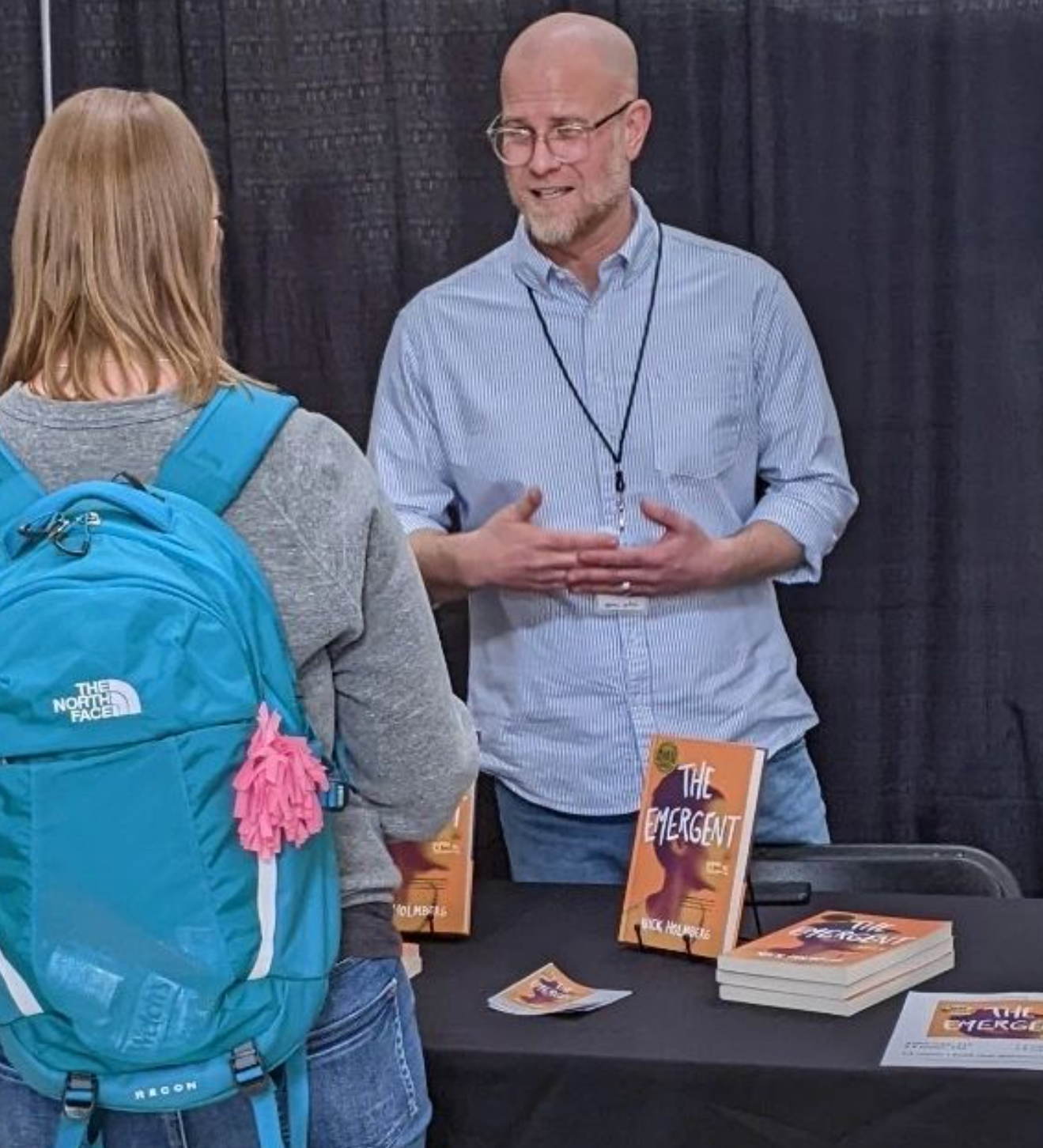
That said, all the hustle has led to fulfillment; by year’s end, I will have done twenty events. As a result, I have gotten to be a little Steinbeckian, chatting with folks about researching my novel, discussing its overt and subversive themes, and defending my artistic vision.


 nick holmberg