selected incidents from the biography of a novel (updated 11/18/21)

The conception-and-birth story of a novel can be grotesque and all too-revealing. With little more than a college-ruled loose leaf from a well-worn notebook to cover my loins, here I go.

20180209_172122 (1).jpg

Of course, I must start even before the novel was an apple in my eye.

Experiences in my youth that challenged my perspectives–and my delicate, sheltered sensibility–can be counted in a small handful. Prior to 1995, there was a Korean-American best friend and his chain-smoking, constantly-yelling mother; my first attempt at eating “sushi”–a California roll–at a Japanese-American friend’s birthday; and going to an Indian woman’s curry-scented house for tutoring in my arch-nemesis: math. Oh! And there was a rumor that a guy on my high school water polo team was gay. Imagine the scandal!

I was merely a new-formed adult by the time I went to San Jose State to study the literature of dead white guys (my favorite being Steinbeck) and a few dead white women (Edith Wharton anyone?) and a couple dead black men (Ellison and Wright blew my mind). When not grappling with writing academic essays and keeping up with my reading load, I was most often found gazing at my navel. For the first couple years, I didn’t do much to step away from that comfort that was–for all intents and purposes–the life of a privileged white kid who, incidentally, escaped arrest for being an idiot several times. More importantly, my skills learned in Spanish classes quickly devolved into the simple, macho banter I had with my Mexican colleagues at the restaurant. Most “conversations” were laced almost exclusively with jaunty Spanglish insults and curses. ¡Puta madre, Chivo! (I was the motherfucking chivo, a cocky goat with wispy hair on my chin.)

But then, the smattering of exposure got serious and voluminous. There was a solo two-month cross-country train trip done on $2k of saved waiter tips. And there was a bartending job at an underbelly dive bar next door to a Greyhound station and a by-the-hour/by-the-week hotel. It was the stuff that turned my literature study into an applied art.

Before I moved to New York City in 2003 to pursue an M.A. in literature and creative writing, I wrote my first successful short story. It was part of my application to CCNY and tested the bounds of my empathy. In all honesty, I surprised myself by choosing to write from a 1st-person perspective that, in some ways, resembled hers. What I wrote for my CCNY application morphed into what now exists as part three of chapter one of The Emergent.

If my social consciousness was still in a somewhat nascent stage when I arrived in New York City, living for a year in the Puerto Rican Washington Heights neighborhood of Manhattan opened my eyes. It gave me a sense (however limited) of being an outsider: I may have been the only white person in a half mile radius. This and other perspective shifts I experienced in NYC entwined fortuitously with my courses. And these factors dramatically affected creative choices I made in The Emergent. I studied in depth the work of the South American and Caribbean magic realists; beyond the early slave narratives, I dove deep into the African-American canon.

With the help from my creative thesis advisor, Salar Abdoh, I had 100 pages at the end of grad school (part 1). Then there was a divorce (yep, skipped right past that first marriage incident) and a death. Writing the novel was on hold for a year or so.

I moved to South Korea in 2006 to teach ESL—what else does a Lit major do? I was fortunate to find new experiences and people. My lifestyle also allowed me the solitude needed to write. I got a new routine, re-discovered confidence, and expanded my book ideas over the course of the first two and a half years in the ROK and completed the first draft in early 2009, shortly after Nic bought me for ~300,000 KRW at a bachelor auction. It was Nic who was my first reader, followed closely by important perspectives from Jaclyn Neal, Cara Cassidy, and Jennifer Holmberg. The first few chapters were critiqued by Amanda Champany and Katie Jensen from the Friday workshops in Busan, ROK.

After Nic committed to staying in the ROK with me for at least another year, it was her turn. I became her GRE coach in writing (though I don’t really think she needed me for anything more than solidarity; mi mujer inteligente can write, too) and editor for grad school application cover letters.

After a three-month barebones tour of SE Asia and Nepal in 2011, service to the careers of mine and Nic’s had to take precedence. (Spouses gotta eat.) And breathing life into this thing seemed to be slipping away. Sometimes struggling to suppress my disenchantment,  I worked three jobs (teaching ESL to international students saved my sanity in some ways, drove me batty in other ways), cooked, cleaned(?), went back to grad school for TESL, got a promotion, and last year moved across the country for Nic’s VA internship. Through all of it, I was searching for a way to get back to the novel. All I could do, though, was bide my time in a state of blind faith by reading as widely as I could and writing (sometimes online) about intercultural and social issues.

I currently live happily with Nic, our nutty dog, and the curse of (self-) critical thought. Yes, happily.

So what better time to bring The Emergent into the world?


exploding genre boxes

For my novel proposal, I have written about the audience I am writing for. When I was writing the book, I was blissfully unaware of how genres were proliferating in the modern publishing industry. For the sake of the art, it was freeing. For the sake of marketing, a little more research was needed.

91oyRDD9S+L._AC_UL320_SR240,320_

The “New Adult” genre is what I came across. But I have been much more influenced by classic bildungsroman literature like Salinger’s Catcher in the Rye, Hurston’s Their Eyes Were Watching God, Hesse’s Demian, Bronte’s Jane Eyre, Steinbeck’s The Red Pony, and Cisneros’ The House on Mango Street. But the publishing industry needed to capitalize on the emergence of a subset of modern readers and writers concerned with the emotionally-fraught time of new found independence.

So, here’s what I have written for the “Audience” section of my proposal:

While there are elements of fiction in the novel that adult readers of all ages will appreciate, the age groups (19-45) defined as my target audiences are Millennials and X-ers. These generations are defined, respectively, as the first generation never to know life without digital technology, and the generation that were in or approaching early adulthood at the dawn of the internet era.

This novel is geared toward anyone who wants to explore modern identity: perhaps it all too-determined by binary coding and algorithms. Was there a certain hapless art that went along with self-discovery that Millennials will never know? How did X-ers deal with those formative years just after high school?

In some ways, my novel most resembles “New Adult” (NA), the 19-26 year-old demographic genre that emerged in 2009. It is a genre characterized by “first-person narration, dramatic…plots, and characters with ‘issues’ ranging from history of abuse, anger management issues, and troubled family lives.” These characteristics are certainly present in my book. However, the NA label is troubling in that it is often linked to Romance and Chick Lit; the sexual content and playful tone of those genres are simply not the focal point of my book.

It is worth noting that several successful contemporary books (e.g. Ko’s The Leavers and Bulawayo’s We Need New Names) were simply designated as “Fiction” even though they share many characteristics of NA. There may be an advantage to simultaneously marketing a book in two different genres. But I believe my novel would be most appropriate if sold as “Fiction.”


the books that bring us together

Thanks for the comments last week, all. It was yet another reminder that literature is a great unifier. The shared experience is so important for me as a way to connect that my reading list is, in part, cued and re-cued as people talk to me about favorite writers and books–novels, histories, biographies. (Sadly, however, I will likely be left out of Tolkien and Rowling discussions forever. It may be the best of fantasy fiction, but it ain’t for me. If you knew you didn’t like peanut butter and mayo sandwiches without ever tasting one, would you change your mind if it was all-natural peanut butter and homemade mayo?)

I received several hearty endorsements after last week’s post. Though I have confidence in my ability to write–and have been grilled and had my writing dissected more than a few times in the writing workshops of grad school–, on my shoulder sits the constant nagging of Doubt. So against that little devil, the backing from readers is a great fortitude.

Some people also reminded me of books I liked in my youth that I neglected to mention. What about Hatchet? How about My Side of the Mountain? Or the Narnia books? (I only read The Lion, the Witch, and the Wardrobe but as an undergrad studied C.S. Lewis’ Till We Have Faces; it, and Joseph Campbell’s The Hero With A Thousand Faces, were key in helping me understand the universality of mythic themes in literature from everywhere on Earth).

Joseph Campbell

A fellow stepchild of the DeKalb, IL corn (Erin Sherrill) told me that she filled her journals with drawings instead of writing and got her grade docked. I think that’s a damned travesty, especially if it still engaged her reactions to reading and/or the world around her.

wrestling with reading

This blog has been up since late 2006. It was first called “Time and Circumstance” and served as a travelogue with ex-pat observations during my four and a half years in South Korea. The second iteration was called “The Ex-Pat Repatriated.” Great title, but it was an era of sparse output, the adjustment to life back in the US wasn’t that interesting; but there was a spike in production and quality around the 2016 presidential election. Now, this blog–with all its past entries–starts a new epoch. It bears the name “a writer’s toil & sound” to document the many aspects of bringing a book–my book, Toil & Sound–to life.

——————

I started writing creatively for the same reason many others try to learn to play the guitar: to impress a girl. Suffice it to say that writing terrible poetry was not the key to this girl’s heart–or many others over the years, it should be known. Nonetheless, at the age of 16, I finally put pen to paper over endless cups of heavily-sugared coffee at Lyon’s restaurant on McHenry Blvd or J Street Café in downtown of the place I spent my youth: Modesto, CA.

The pull to write has been with me as long as I can remember. I’ve never quite figured out the origins of this pull toward producing the written word: I really didn’t read much when I was growing up. And it wasn’t for lack of a good example. Both of Mom’s parents always had half-read books on the coffee table when we visited. My parents read to me when I was a wee lad. Dad was always a big reader of histories and biographies and fiction. My brother could rarely be found without his nose in a book; throughout the fourteen years that we shared a room, I would wake up on weekends to find him in his bed reading.

Mom tried what she thought was the right way to get me to read. During summer mornings, she would tell me to read 50 pages before she got home from work; I can’t remember ever finishing one daily summer reading assignment, moving the bookmark up 50 pages in any given book. I mean, why not? I was never asked to give a summary of what I had read. Mom was probably too tired from work to follow up.

Having said that, it wasn’t like I didn’t read; it’s just that once I got beyond the Stuart Little and Superfudge phase, shit that was available was just boring to me (with the exception of The Indian in the Cupboard and The Bridge to Terabithia). Unless it was picture-heavy pages–a coffee table book on the history of America, the 28-volume Time-Life series on the Civil War that my dad had read from beginning to end, or the years and years of National Geographics my parents kept–, I would rarely crack a book without some sort of resistance. Instead, I could be found outside chasing and killing Soviets in ongoing battles fought on foot, in trees, over fences, and on bicycles. When I wasn’t eradicating commies from the neighborhood, I was playing Nerf football with friends in the street or homerun derby with a tennis ball at the high school’s tennis courts. Later, it was girls who captured my imagination rather than Great Expectations, Les Misérables, or Greek mythology (though I was taught Animal Farm in an outstanding two-week lesson my sophomore year). Oddly, I really jumped into vocab study in preparation for the SAT.

Reading became more of a necessity when I left home at the age of 18 to study literature at SJSU. With the kind of relationship I had with words up to that point, I had quite an uphill fight my first year. Not only did I not have a less-than-stellar high school academic history and a piss poor reading habit, I was also away from home for the first time. It is useful here to paraphrase Homer J. Simpson: booze, pot, and Sega Genesis are the causes of and solutions to all of life’s problems. But long, marijuana-addled treks in downtown San Jose with Alice in Chains, John Coltrane, Bad Religion, or Rachmaninov on my Discman coincided with the creative and critical thought I was somehow picking up in my literature courses. By the time I started my sophomore year, I found a balance between work and play; a routine was put in place necessitated by part-time work and a full load of classes. I saw the results of this hard work in my grades. And the more I read, the more I wrote. In downtown San Jose my need to write took firm root.

This is why I claim San Jose as my hometown: it’s the place where my Self emerged.

11219402_10153629953516224_7439674588971186285_n

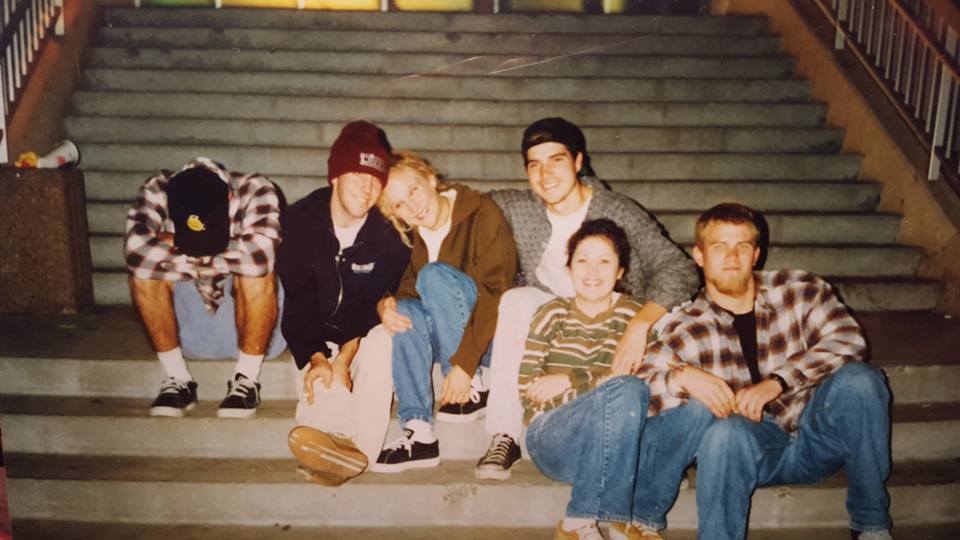
Dorm rats Fall ’95

Including my first several handwritten notebooks–now transcribed, with the exception of the first, which was stolen–, the writing of love and heartbreak and selfhood and narrative experimentation are 16 volumes, (75 pages each with 10 point type) that span 1995 to present. These will not see the light of day while I live. Even then, I may ask that the funeral pyre is kindled with those pages and my hard drive.

The pathetic misery and awful writing and sheer repetition take up 90% of those volumes. I had to learn to be patient with myself over the years, as that remaining 10% has been polished to become short stories and scenes from the novel.

of Harvey and humility

As the waters rose on Saturday night, Nic and I were out with the dog, trying to get him to do his thing one last time before the brown waters covered the green. Who knows when we would see it next. Suddenly, there was a young black man, his sister (baby in arms), and their mother. They had to abandon their car in our garage before trying to find their way to their apartment. It was only across the road. But the water was rising, the situation changing as rapidly as the water rushing down the road. But the gates to our apartment were closed; to their knowledge, there was no way out of the complex. All I did was use the fob on my keychain. The gate opened. Then what? I urged them to go, to be careful of the fast-moving water. The fear was palpable. The young man ran across to make sure the gate to their apartment complex would open. It did. And somehow the young woman, baby, and mother made it through rushing water shin-deep. They could have been swept away.

21105410_10155456567346224_2795086333716173778_n

Soon, our apartment complex was an island. We lost power and water almost simultaneously the following afternoon. We were somewhat prepared: water, canned food, ice. Empathy.

We were unprepared: guilt, helplessness. Empathy with the inability to act on it.

Houston is one of the most diverse, integrated cities I have ever lived in. Granted, I’ve only been here for eight weeks, but I think our raised apartment complex parking garage could have been a microcosm of the city. For the next couple of days, all sorts of people milled about the cars that were jammed in as many open spaces as possible. People were trying to get their pets to do their business on the concrete, while many others were just walking endlessly in circles on the ramps to stretch their legs, to triage their cabin fever. Others sat for hours charging their phones in their cars and listening to the news, and still others collected rain water in buckets. It’s safe to say that virtually everyone who had access to the parking garage remedied their fear and uncertainty by talking to folks they had never talked to before to trade stories, to check on general well-being. I got Frank to pee on a palm frond and shared that tip with a middle-aged white woman whose only companion was a two-time cancer-surviving 13-year old lap dog who hadn’t peed in 36 hours.

There was an amphibious and aerial rescue operation at the apartment complex across the street on Sunday evening. People–Latinos, whites, blacks–who had hung out together on the second floor walkway all day talking–and laughing, even–were plucked and taken to safety.

21191968_10155456855561224_7527533707390016903_n

Anxiety–for which we were unprepared–was very real in spite of the fact that we were four floors above the 5 feet of water on the ground below. We went to bed early that night, the rain lashing our window, trying to get in through a little crack; I felt it was within the realm of possibility that the wind would push it in. Why not? So many things outside were crumbling.

I texted a few of my new acquaintances–a white woman from work, a Brazilian woman from work, a few black folks from the apartment gym, a visiting scholar from Bangladesh that I met at Rice new employee orientation a few weeks ago. Almost everyone is okay, having suffered none, some, or a lot of flooding. I have yet to hear from my Bangladeshi friend, who is a new dad and has a wife who speaks very little English.

From our tiny balcony, we watched abandoned vehicles appear as the waters began to recede late Monday. Army Corps of Engineers drove their big green trucks, one of which was flagged down by a Latina with her 4-year old in her arms. She had had enough.

By Tuesday night, I had had enough of watching from the balcony. The water was almost all gone, and I had watched three men clean out a car for much of the afternoon. I grabbed my remaining beer (bouzhy shit from local craft breweries and a few tallboys of The High Life), took it across the street to offer help and refreshments. My broken Spanish was pressed into action, as these gentleman were Cubans; we shared a drink and a couple of laughs at the expense of my language learner’s ego. We pushed the car to an easier place to work. As night fell, I shined a light on the engine as they sprayed it out–I will forever be unprepared for dealing with car-related issues. Los Cubanos had been up for hours; they had housed 16 people in their second-floor two-bedroom apartment over the last couple of days; they had had friends airlifted a couple days before. Carlos “Segundo”–as we decided to differentiate–, his father Carlos “Primero”, and his friend Carlos “Loco” all had to work the next day. Yet they insisted that I share a meal with them–barbequed bisteque prepared by Segundo’s 8-months pregnant wife.

Yesterday, I was incredibly restless. Nic was back at work, and I needed to do something. Several of the more organized efforts at evacuee relief (Red Cross, homeless shelters, food banks) have vetting processes to go through. I filled out many online applications. Though the recovery effort will be long and my services will be needed for weeks and months to come, I had to do something. Somewhere along the line of my humanistic development, I was not prepared to be okay with just being alive. I took our remaining water reserves to a women and children transitional residence south of downtown.

That was enough for yesterday, as driving around was still ill-advised.

Today, I tried to stop in at NRG Stadium but, as I expected, was turned away because my Red Cross application had yet to be processed. I toured the road along the bus route I take along the Brays Bayou. Homes had been disgorged of destroyed contents; a group of Catholics had come through to help empty out houses of entire lifetimes. Accumulations lay in junk heaps along the curb. I turned into a neighborhood not far from our apartment; before dawn, I had taken the dog for a run here and saw silhouettes of the same type of domestic entrails piled in front of homes. But upon returning in the daylight, a whole new level of reality set in.

Where do I begin? Where does anyone begin? I helped older Jewish man and his employee clear out a few things from his home office (chairs, ruined blue prints, stacks of correspondence). When I first asked what I could do, the man said he wanted to get the pool up and running again; his employee directed my efforts elsewhere. I walked down the road farther; the Catholics had apparently been through this area the day previous, helping to get all the ruined furniture to the curb. But there was still work to be done. I helped a black man load up a fridge onto his truck, contents of once-frozen chickpeas and pesto spilling out of the freezer compartment.

I am unprepared for this. I need gloves. I also need organized guidance in my first natural disaster recovery effort. I will cast about the surrounding areas doing little bits to help anyone until I get a call.

The DeKalb Era–a not-so-postmodern postmortem

After the haze of the last few weeks of discarding all sorts of personal memorabilia in preparation for the move, a thought beyond logistics had not emerged. My life packed up in a 12-foot yellow moving van, I rumbled and bounced toward the 400-mile day on the road, wife following in the black Highlander with the dog. I noticed the corn is the height it needs to be; Nicole’s grandfather echoed in my mind: the corn should be “knee-high by the 4th of July.” It’s mid-shin. Things are right on track.

I adjusted my driving. Went the speed limit. Battled the crosswinds. Struggled at times to stay out of the ditch. Thoughts of anything other than staying alive were not emerging. It’s been far too rare in my post-Korea epoch that driving provided any sort of meditation, strange collaboration of the outside world and my inner life. In spite of a well-curated 15-hour playlist set to random, the likes of Frank Black and the Catholics, Rush, Soundgarden, Audioslave, Radiohead, or a piano tribute to Tool did not jog a thought. That is until 100 miles south where the corn is already chest-high by the 25th of June.

Django Django’s “Default” knocked something loose. The new ideas disparate, but the beat of the song sounded like a hand slapping a knee, goading some sort of deliciously perverse square-dance between reality and other. And a set of four songs seemed a soundtrack to a storyline yet to be aligned: Soundgarden’s “Mind Riot”, The Bravery’s “Tragedy Bound”, Rush’s “The Trees”, and Audioslave’s “Moth.” I took up the jigsaw presented by random play. The story involves destruction. And that is all I could tell you right now. But I tried to procure something from the sights.

Meaning be damned? Very post-modern.

North of Springfield, Springfield, south of Springfield, north of St. Louis. The corn was head-high, yellow tassels atop. Man on a motorbike, a portion of his life and a stuffed Yoda strapped to the back. Dead coyotes. No dead deer. Dead raccoons, ringtails fluttering in the wind of passing traffic. A horse trailer abandoned along the road. Dead horses? The rolling hills of central and southern Missouri along Route 67. Why isn’t there any logging here? 100 miles north of Poplar Bluff, there is a stretch of abandoned motels and filling stations while fully-functioning churches dot the landscape.

the ruins of ruins


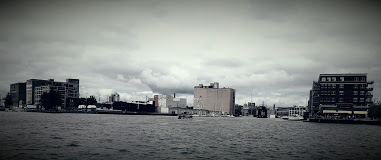
Two Saturday afternoons ago in the heart of downtown Milwaukee, my wife’s family and I–a contingent of seven–went for a four-hour ride on a rented pontoon boat. As we three couples and a chubby one-year old waited for our boat, others got in line, all prepped for their respective booze cruise, prepared to see the city’s skyline through alcohol-softened lenses.

mke 4

Paradoxically, we were going to cruise among the ruins of ruins: developers came through about fifteen years ago and embraced the decay by converting abandoned warehouses into expensive townhomes, lofts, and apartments. The ruins of industry never looked so inviting. Very few buildings have not been repurposed, but the even the industrial rot–namely, old turnstile bridges deep brown with rust’s age–is left to stand as reminders of what downtown used to be: booming in textile and beer production, forsaken for suburban and rural lands. Downtown used to be cheap and undesirable, home to the marginalized. Gentrification happened, and here we were, a line of white folks with some money to spend on a boat ride to entertain ourselves by looking at the shiny ruins of ruins. Throughout the hours in Milwaukee, I saw exactly two black men. One looked down on us from a bridge as he walked across with his comrade and hollered something that I couldn’t understand.

mke 1mke 5


Two Saturday nights ago on the fringes of downtown Milwaukee, there was a shooting of a black man and subsequent riots. An apparently armed black man of 23 was killed by a black cop, aged 24. (They had been high school classmates).

The absolute absurdity of it all strikes me. With the killings of unarmed black men a common sight on captured video from cell phones or dash cams or body cams, the excessive force used on black men–armed or not–seemingly fairly common, it is no wonder that blacks are upset. But that this man was killed for supposedly brandishing his gun at police officers seems justified. Wouldn’t anyone who was threatening law enforcement with a  gun be shot just the same? Perhaps not, but it seems within the realm of logic. It seems also within the realm of logic that people, before destroying businesses in their own neighborhood, would ask the question of whether or not there might be some facts missing, that perhaps there is still such a thing as a justified shooting of a black person.

mke 3

The sensitive state of racial relations in the union make my comments above feel racist, in spite of the use of carefully qualified language like “apparently” and “seems” that reveal mindfulness of my own ignorance; in spite of my increasing consciousness that my status as a white male gives me an extreme statistical advantage over most everyone else in the country; in spite of the fact that I write this in a feeble attempt to process the complexities of racial relations in the US. The black sheriff of Milwaukee County, David Clarke, seems to have similar thoughts. His Twitter feed on Saturday read:

Four murdered, 9 shot in Milwaukee Fri night/Sat morning. Silence. 1 cop kills an ARMED black guy & riots break out?

He has also made this political by writing in the DC-focused The Hill that it is the policies of Democrats that create situations like these in the US.

The actions [of Milwaukee’s poor blacks] were the manifestation of a population with no hope, no stake in the American dream that could provide advancement and purpose and pride of self. They are the ones lied to, exploited by and ultimately manipulated by the Democrats who claim to care. They are victims of the left, but they are not without blame.

It was the comments he made that not only helped me to examine another perspective than my own left-leaning politics (an all-to-common side-effect of algorithmic search engines), but it forces me to examine what can be done. He also writes briefly about the poor educational system; this is a valid argument in that there seems to be a lack of critical thinking evident in most strata of the populace. Indeed, blame your biased news feed, but don’t forget the ailing schools.

mke 2

The nation has become so polarized due to the short attention spans and the lack of wide reading that the term “seeing things in black and white” carries a dangerous precedent. All killings of blacks are perpetrated by white officers. All blacks who are killed had criminal records, were carrying guns, had mental problems. All blacks who are killed by cops are killed without justification.

Because of my wife’s comments over the years, I have come to the understanding that Milwaukee is one of the most segregated cities in the country. Economic and geographic facts seem to quantify this statement, and Nic’s time living in Milwaukee-proper surely qualifies it. Given this characterization, I would hazard a guess that it is much like any other major metropolis in the US that has recently felt racial tensions and has had protests: the perceived brutality of the police is distilled into one dash cam video that sets off a conflagration that, to people like my father-in-law, was just a matter of time–“I knew this was going to happen.” But then there is his illogical, contradictory statement, “Why is it that black lives only matter when a black person gets shot?” In a different context, this certainly carries some truth to it: what are people (of any race) doing to combat the growing racial tension? What is the black community doing to help keep the peace? What are cops doing so they can avoid unjustified shootings? In the context of my father-in-law’s statements, though, there is a presumption that absolutely no one in the black community is doing anything to affect change. According to Clarke, this is not the case. More importantly, the belief that blacks only care about black people getting shot by cops implies two absurdities: that the ratio of other groups of people being shot by the cops is proportionate to that of the black community; and that the black community–the community that is statistically the most oppressed, at least in Milwaukee–should give a flying fuck about other communities not under siege in the same way: shot, deprived of education, and incarcerated in disproportionate–or should we say, predetermined–numbers.

“Black Lives Matter” (termed “Black Lies Matter” by Clarke) may be perceived as militant group that perhaps sprung out of the ineffectiveness of other–non-violent–movements in the black community. That could be part of the issue right there: movements within the black community. Where do whites fit into all of this? Are the conspiracy theories true: that the state of racial unrest is continually perpetrated under the guise of different, subtle policies that have become more difficult to detect even as the populace has become more educated?–if we can call “educated” to mean access to the un-vetted “reporting” and “research” on the internet through the biased algorithms of search engines and the brains afflicted by short attention spans.

The very problems of racism have been perpetrated for centuries by white government, from slavery to separate-but-equal to the institutionally-biased systems of economy and education. A black president in the white establishment has had little or no chance to make significant changes in 8 years of administration. Don’t get me wrong: Obama has not been perfect, his foreign policy one of dubious nature at times. Nonetheless, not even his seemingly non-racial policies have been allowed to see much light; Obamacare was stripped of traction (perhaps even because it would seem to benefit the less fortunate: the non-whites). The blocking of Obama’s legal right (and duty) to appoint another supreme court justice after the death of Scalia; it is within the realm of possibility that it was just those obstructionist Republicans/Tea Partiers would have been just as disruptive for any Democrat who has already been able to successfully put forth two new justices: Sotomayor and Kagan, females to boot. Even with that all said, Obama has put forth moderate and white Garland, what could be seen as a compromise. Hell, Obama has never floated the idea of a black person to sit the bench. The point here is that the white establishment has put up so many roadblocks to cooperation or negotiation that the intransigence comes across as a result of institutional racism. Lead by example.

So, what can the white establishment do to make changes besides make urban ruins unaffordable? And to the degree that it is within the larger white establishment, what can black communities do besides allowing the angry and under-informed to ruin neighborhoods as a form of expression?

What can I do besides ruin my liver and dull my faculties while staring up and out at polished old warehouses and textile factories, vaguely wondering what used to be?

And what is.


On Weiland and other artists

“A good book…leaves you wanting to reread the book. A great book compels you to reread your own soul.” Richard Flanagan, The Narrow Road to the Deep North (p.22).

It’s the day after Scott Weiland was found dead of a drug overdose. Nic broke the news to me. I was not shocked in the least. Not like I was with Cobain’s death. Age and pop cultural literacy have lead me to expect such news. Layne Staley’s death (April 2002) was glossed over in my mind in much the same way Weiland’s death was more recently: well, that was inevitable.

But what is significant is that the death of Staley didn’t have more of an impact on me. Alice in Chains’ self-titled album came out the year I left home for undergrad literature studies (1995); that album always takes me to that first autumn away from home as a barely-average student who played Sega and discovered the true wonders of THC-enhanced music during long walks. Something more important changed after a semester sabbatical journey across the northern states and into Canada. Two of the few CDs I took with me were Dirt and Jar of Flies. When I returned to school in the spring of 1997, I would nap for 30 minutes every afternoon after classes and before studying and listen to Jar of Flies on that well-worn CD. It was as if it were some sort of torturous inspiration to continue through the trials and tribulations of really learning to read great literature and really executing literary analysis.

Over the next two or three years, I started my evolution from a journal-writing whiner and mediocre academic hack into a self-proclaimed writer. And there was the discovery of Rachmaninov and Monk and Coltrane and Miles D and Tyner and Mingus and Clarke. But looking back, Jar of Flies is my most listened-to album of all time, having accompanied my naps since my senior year of high school until my modern manifestation. And Dirt is a close second, as it was (and will be again as soon as grad school Part II is complete next week) almost always the album that helped me pound out the first hour of any freewriting session before and during grad school Part I (NYC 2002-2003) in which I wrote the first 100 pages of my still-unpublished tome called Toil and Sound. And during the next seven years of working on that novel, Dirt fueled my writing warm-ups as Jar of Flies stimulated terrifying half-asleep dreams of death by suffocation.

So, what of Weiland? Well…jazz, classical, and grunge/90s alternative married in my mind to create the perfect organized chaos I felt I needed to complete my writing and my studies. Classical is always for reading and editing. Jazz has a crossover effect: depending on the mood, I can read with “Kind of Blue” or write with “Big Nick.” But the dark, drug-influenced rock that has been along for the last twenty years of my development into humanhood is used for long drives (during which I often compose in my head) and real writing. I’ve completed a few good short stories and a hopefully not-dead-but-definitely-bloated novel on a regular diet of Dirt, Jar of Flies, Core, Purple, and Tool’s Undertow (1993), AEnima (1996), Lateralus (2001) and 10,000 Days (2006). Weiland’s singing voice has inspired my writing voice as much as Staley’s and Keenan’s.

Nic’s grad school has been my grad school, too. Whilst she’s studied, full years of not-so-lazy Sundays have been given to cooking, cleaning, bad television. And my own heroins–coffee, whiskey, and beer (in no particular order of importance but in certain order of consumption). Thanks to my own return to grad school (2014-2015), it has now been well over four years since I had a regular writing habit. A writing habit of fragments. And…ellipses. And sentences starting with conjunctions. And fuckoff to the dreaded, soul-sucking “howevers” and “therefores.”

Other than the handcuffs of convention that academic writing puts on its practitioners and instructors, there is the other unfortunate part of going back to grad school: being limited during study and dry writing to classical music. Don’t get me wrong. I will never grow tired of Beethoven’s five piano concertos back-to-back. Nor will I stop listening to a new favorite, Dvorak. But…

Staley inspired empathy through his voice: I’ve never done the drugs that he and his old man did, but I sure have had my share of dreams in which I shot heroin (the aftereffects were terrible: I woke up.). Weiland inspired wonder: to this day I have yet to figure out why she slept in the bathtub, except for the fact that water cleanses, you know?

To inspire empathy. To inspire wonder. These are the work of great writers and poets. So, come back to me, inspired words. The academically tired seeks to be done with orthodox transitions and impeccable conclusions. The academically tired craves running his eyes over Moby Dick for the fourth time, or Americanah for the first time while soaking in the glory of Schubert’s incomplete symphony or Coltrane’s “Afro Blue.” The academically tired needs months of five-hour writing stints finding his voice again while listening to the voice of StaleyWeilandKeenan.

Alas! The academically tired just spent an hour and half procrastinating on this page while his last annotated bibliography sits one-fifth finished.

Your terrorism, your heroism.

The news from Paris yesterday morning is staying with me despite the fact that every day I see and hear acts of violence, desperation, and idealism–and it needs to be said up front that these horrific acts are perpetrated by all races of people: the godless and those acting in the name of God. Terrorism is to heroism what heroism is to terrorism. With an event such as this, too many people I know fail to do a little perspective-taking before blathering bigotry and patriotism on the internet or at social gatherings (for example, check the comments of your “friends” on Facebook following the Michael Brown grand jury verdict).

You might say, well, this is their right to speak their minds. Agreed. But it occurs to me that freedom of speech comes with a fair amount of responsibility, not unlike the American right to carry a gun.

Salman Rushdie (a Muslim-turned-secularist critical of all organized religion, most famously of Islam) and his colleagues published a manifesto of sorts in 2006 in Charlie Hebdo. The decree is clearly against what it calls “Islamism”, a concept the writers equate to oppression of free thinking and free expression. Rushdie, et. al. make clear that their protest is, de facto, against any and all oppressive ideologies, not of faith itself. At its core, there is much with which to align in the work that these writers and activists have done in the name of freedom of speech (Joseph Anton gives Rushdie’s account of much of this). However, does not the use of the term “Islamism” smack of provocation, just as the series of cartoons that inspired yesterday’s attack in Paris? The writers and activists and cartoonists of whom I speak make/made their livings with words; they make/made their word choices and pen strokes carefully so as to cause a reaction, with violence a very real variable. Now those at Charlie Hebdo are martyrs for the cause of free speech…or simply purveyors of the tit-for-tat that perpetuates the mistrust and future violence–drone strikes, anyone? mall attacks, anyone?–between the Middle East and the West. Extremism is to righteous defiance what righteous defiance is to extremism.

Some may ask, if Rushdie, et. al. don’t speak/act out, who will? Couldn’t the same be said about the attackers today? Both sides see each other as the oppressor.

Perhaps this event has stuck with me because I saw a man executed on television. Again, if you watch enough television or movies, or spend enough time on the internet, you’re probably as anesthetized as most others in America. Is it true that there really is nothing shocking about death in and of itself? If this is true, why does this event affect me so much? (Admittedly, I watch my share of realistic violent movies and television; it is my feeble, insulated attempt at contemplating the extremities of human suffering for the purpose of cultivating empathy.) After seeing the actual footage of the execution of the police officer lying on the sidewalk in Paris, I noticed that the video footage was later replaced by a still-frame of the masked gunman pointing his rifle at the police officer’s head. The later omission of the video reminded me of trapped people jumping to their deaths out of the twin towers: if you were watching early enough on that September day, you saw raw footage of this; later and ever since, those moving images are harder to come by. Is this some sort of respect for the dead? Some sort of sterilizing of the actuality of the final terrible moments of a person’s life? Some sort of social responsibility exercised by the newsroom producers?

“Social responsibility” is hardly a term I would apply to much of the journalism and media out there. Nonetheless, wasn’t it a sense of “social responsibility” that drove the writers, activists, and cartoonists to do what they did? Wasn’t “social responsibility” the reason the gunmen did what they did? “Social responsibility” seems inevitably corrupted when paired with the concepts of national or religious ideology. Social responsibility, in its true sense, in its most elemental meaning, is a term that should be contemplated before taking up words or guns as weapons for righteousness.

This event touches me–a humanist–as any other event of violence should. I teach people who are affected by the acts of extremists because the acts of the extremists perpetuate a stereotype; the stereotype will propagate marginalization. I am a person who is affected by the atrocities of those individuals representing American/French/British “interests”(see CIA; see reasons for radicalization); the brutalities will propagate global mistrust of me, many of my friends, and my family.

While reading background of the events and individuals involved in yesterday’s attack, I came across an article that distills the crux of the problem: hypocrisy. The article describes how anti-Semitic books are openly sold in the streets of Cairo, a place in the center of the Islamic world, the Islamic world that expects everyone in the entire world not to depict the Prophet. I was always taught that if you want respect, you have to give respect. By that same token, why do some Christians–the ones whose religion is named after a man who preached acceptance of all people–ostracize so many members of the global society? In the end, doesn’t the duality of human nature lead us to believe that human nature will never change?

out of sight, out of mind

For some reason, I can’t bring myself to just throw out stuff.  Even now, after all the bedlam that this house has been—dust buffaloes and all—I’m finding places in the kitchen to put my used but perfectly usable pans in a cupboard, pushed all the way back so only a new tenant will find them.

A strange things it is here in Korea when you move out: you don’t have to clean those buffaloes, you don’t have to wipe down the sink or the toilet.  We are happy for this fact because, even with all the stuff we’ve gotten done, today there is still the bank to visit (exchange all the KRW coins, transfer money home, pay bills, get Maylay Ringgets, tell our credit card people not to cut us off since we’ll be in six countries before mid-May); there is still the post to visit (we still have seven boxes or so to send home, not including Nic’s computer and the external hard drive and all the important docs we have with us, i.e. diplomas, marriage license); send off a resume for an online teaching position; have a cup of coffee; donate the rest of my clothes; go to one last Russian tea party.  And those are the things I can remember off the top of my head without a cup of coffee in my system.

We have it in our heads that all of our stuff will be taken care of today.  We’re probably out of our minds to think this may happen.  We’re also a little daffy for thinking we’re going to make it one last time to our favorite mountain top—the place where I proposed to Nic.  If we don’t, I’ll be okay with it because that place exists firmly in my mind.  Besides, the result of repetitive lifting (in the wrong way) has manifested in a pinched nerve or a strained muscle in my lower right back that now has me adding something else to the list: go to acupuncture.  With all the aches and pains (knees, neck, upper back, lower back, shoulders), being the symbolist that I am, I am inclined to believe that it is time for me to leave Korea.  Tomorrow.  Sun and humidity and nothing to lift but my book, my beer or my 11 kilo bag will be therapy for me.